Hi! We’re proud to bring you this newsletter free of charge. But you know what isn’t free? A lot of the other journalism Slate publishes every day, much of which helps drive the Slatest. So if you’re a fan, please consider signing up for Slate Plus. Celebrate Slate's 30th anniversary with a special 6-month trial of Slate Plus for just $19.96.
Your support makes what we do possible, and in exchange you’ll get access to unlimited articles, subscriber-only newsletters, and more. Happy reading! |
|
|
|
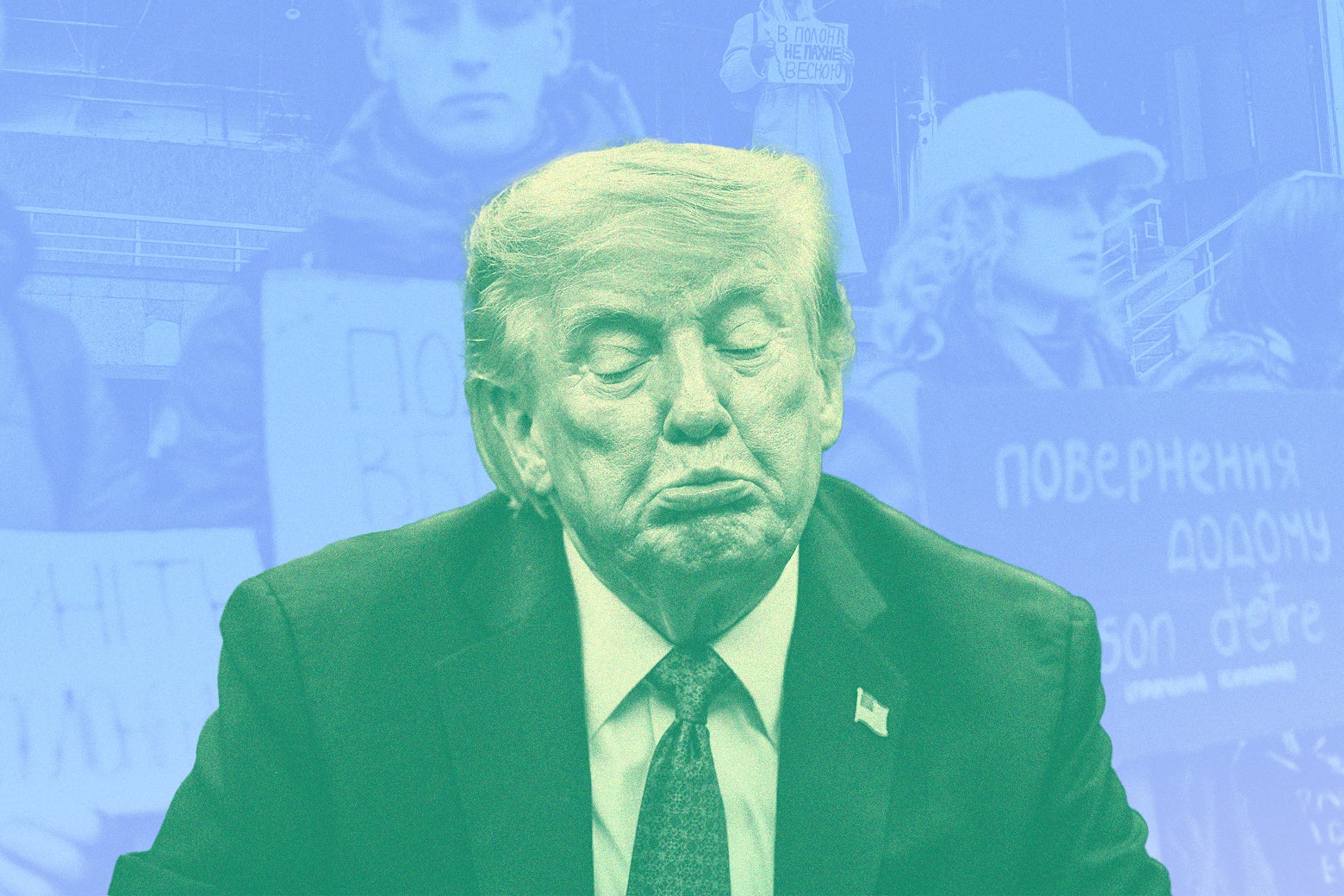
It’s been a rough week for Ukraine, less because of anything happening on the battlefield and more because Donald Trump’s hot-and-cold relationship with the embattled country has once again gone frigid. Last Friday, Trump announced a plan to import millions of barrels of Russian diesel, which has been under U.S. sanctions since shortly after Russia started the war with Ukraine. Trump savaged his Ukrainian counterpart, Volodymyr Zelensky, over the weekend, saying, “I think it’s time for Ukraine to get a new president.” And this week, according to Reuters, the White House temporarily limited Ukraine’s access to a SpaceX-made satellite system it uses for battlefield communications.
Those developments have understandably sent people who care about Ukraine’s future spiraling, convinced that the ostensible leader of the free world has shown his true cards. Buying Russian diesel would effectively subsidize Vladimir Putin’s war effort (even as U.S. taxpayers are already helping arm Ukraine). Ukraine’s satellite access seems to be coming back, but the interruption foiled attacks and cost Ukraine military drones. Zelensky appears to be losing patience, too, expressing betrayal after Trump demanded Ukraine stop attacking Russian energy infrastructure even as Russia continued to attack Ukraine’s. Seen in the context of Trump’s long-standing admiration for Putin, it’s hard to conclude that these developments are anything but bad for Ukraine.
But is Trump’s turnabout permanent? At the risk of sounding like a contrarian, the truth is that he has waffled over the war more often than not. In some moments, like when he accused Zelensky of being insufficiently grateful for U.S. support last year, Trump has taken Putin’s side. But begrudgingly or not, Trump has also meaningfully helped Ukraine by agreeing to let it manufacture American weapon systems and by joining Europe in levying more sanctions against Russia over the summer.
One reason Trump’s latest pivot against Ukraine might not last is that his diesel deal looks more like an act of desperation than a lasting strategic shift. As we’ve explained before, Trump is scrambling to lower U.S. gas prices, which his war of choice in Iran has elevated, ahead of the midterm elections. Despite his claim that prices “will be COMING DOWN, IN RECORD NUMBERS, AND FAST!,” the deal probably won’t do much to alleviate Americans’ pain at the pump before Election Day. But getting caught trying rarely hurts, and even small decreases could be enough to save endangered Republican candidates, who can use all the help they can get.
Trump approaches international relations in personalist terms (he often describes foreign leaders as his friends, even when they aren’t), so his pivot back to bashing Zelensky is arguably a more worrying development. But a second reason to doubt whether it will last is that a surprising number of Republicans are pushing back. Several GOP members of Congress have joined Democrats in objecting to the diesel deal. Republicans facing tough races—including Ashley Hinson in Iowa and Mike Rogers in Michigan—have also criticized it. Republicans don’t stand up to Trump often, but their pushback over Ukraine has helped block some of his more damaging efforts, including trying to withhold U.S. weapons in his first term and threatening to pull the U.S. out of NATO in his second.
None of that makes Trump’s turnabout, however long it lasts, any less of a betrayal. Whether his affinity for Putin owes to political desperation, autocratic envy, or profit motive (Trump’s negotiations to end the war reportedly include an oil deal that would enrich investors in his family’s ventures), it has already cost Ukrainian lives. But it may also come back to haunt Trump. By placing the U.S. in the position of supporting both countries’ competing war efforts, the president who campaigned on ending the fighting in 24 hours is arguably helping prolong it. Talk about winning the battle but losing the war.
|
 |
Understand the world with the help of the Muppets: In 2012, Dahlia Lithwick published a piece of cultural analysis that permanently altered how readers viewed their marriages, their workplaces, and the U.S. Supreme Court. At its core, her theory reveals that everyone is either a freewheeling Chaos Muppet (think Gonzo) or a steady, conscientious Order Muppet (think Kermit), and the world runs on the balance between the two. To celebrate Slate's 30th anniversary, Dahlia revisited the theory with longtime Slate favorite June Thomas for a special Plus-only episode of Amicus.
|
|
Take a trip to Blorple Falls: Back in Slate’s earliest years, the magazine took a detour from covering the real world and decamped to a quirky town in “West Carolina” known as Blorple Falls, populated by fictitious personae like conservative congressman Blanton Foghorn and his pop-star niece Mindy D’Stasio. Why would Slate go to the trouble of creating this alternate reality? Katy Waldman went down the rabbit hole to excavate this weird chapter of internet history.
|
|
Rethink your birthday plans: As a kid, you get a birthday party. But when you grow up, you’re stuck with a birthday dinner. In 2008, John Swansburg argued that we should ditch this particular festivity: “Seems like a nice idea, the birthday dinner. It is not. It is a tedious, wretched affair.”
|
|
Get sucked into this quicksand investigation: Quicksand used to dominate pop culture, but its heyday is firmly behind us. How and why did the tide turn against this sticky substance? In 2010, Daniel Engber took a deep dive into quicksand, approaching the topic from such diverse angles as its depictions in film and TV, the fetish scene devoted to it, and its shifting role in political rhetoric.
|
|
It’s been another busy week of news, and I, for one, am ready to take a breather. But rest assured, we’ll be back in your inbox with more wild happenings on Monday. Enjoy the weekend! —Ian |
|
|
| | Two newsletters. Zero doomscroll. |
Pair your nightly wind-down with an essential morning wake-up call. Sign up for Your Morning Slate to start the day with the best of Slate in your inbox. |
|
|
|
Slate is turning 30! Celebrating by visiting our retro 1996 homepage with daily archive drops and 6 months of Slate Plus for just $19.96. |
|
|
|
Photo illustration by Slate. Photos by Daniel Yovkov/Hans Lucas/AFP via Getty Images and Kevin Dietsch/Getty Images. |
|
|
|
15 Metrotech Center, 8th Floor, Brooklyn, NY 11201 |
|
|
|
|