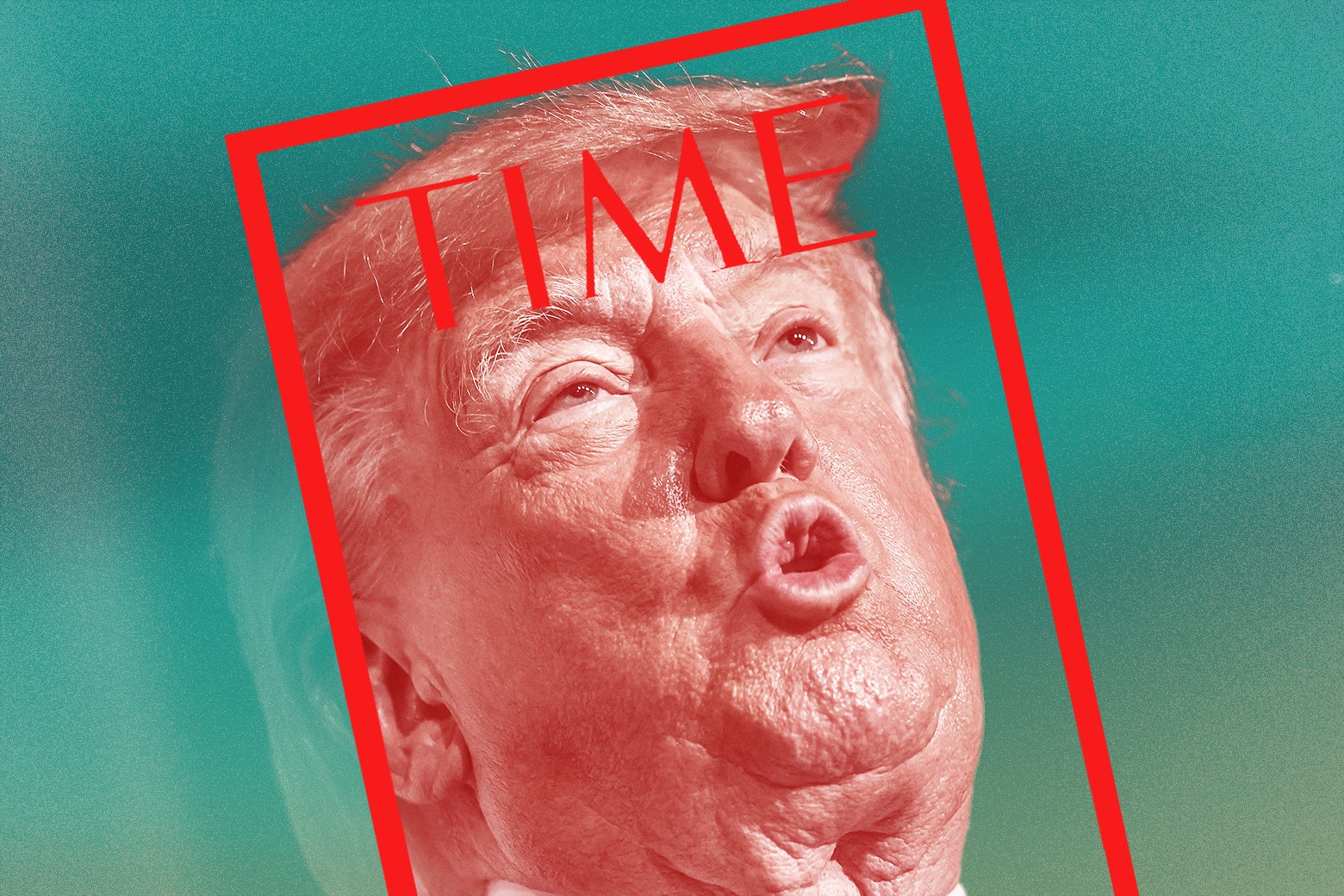
Donald Trump talks constantly, which makes it a minor miracle that he can still surprise us. But he did today after Time magazine published the full transcript of a 75-minute interview with the president. Conducted this week by correspondent Eric Cortellessa and top editor Sam Jacobs, the 11,000-word interview is in some ways an unremarkable artifact of the president’s usual tics: run-on sentences, bluster, insults, lies. But it also contains moments of confusion, incoherence, and paranoia that look like windows into Trump’s mental state. Far be it from us to diagnose him from afar, but suffice it to say that if any other president—or person—spoke the way Trump does, you’d probably worry about their psychological and perhaps medical well-being.
1. Trump immediately gets confused about where he was this week.
The interviewers open by asking about Trump’s Sunday dinner with Dario Amodei, CEO of the A.I. company Anthropic. They asked whether the president agrees with Amodei’s concerns about A.I. endangering humanity, but Trump chose to linger on a more important topic: the Presidents Cup golf tournament, which delayed the dinner until late. “I was the chairman of it in Chicago at Marion, which is great,” he said, incorrectly. The tournament actually happened at a country club in Medinah, Illinois. The president then caught his error, sort of: “Actually, that was yeah, Medinah, at Medinah, last year, Marion, this time of year.” Except there was no Presidents Cup last year; the tournament happens every other year. It has also never been held in Marion, which is in Massachusetts (nor at Merion Golf Club in Pennsylvania, which I checked in case Time’s transcript got the spelling wrong). The mixup is unlikely to make many headlines. But during 2024’s national debate over Joe Biden’s mental acuity, this type of confusion was cited (not unfairly, in some cases) as evidence of cognitive decline.
2. When it comes to Iran, Trump is on another planet.
The interview understandably dwells on the war the president started in February, which has killed at least 19 Americans and thousands of Iranians in addition to spiking gas prices around the world. Trump’s answers revealed just how detached from the reality of the situation he has become. Asked why the war has lasted more than seven months despite his early promises that it would only take weeks, Trump claimed to have “met my timeline” but then “decided I wanted to go further,” an escalation he never explained publicly and certainly never asked Congress to approve. He also blamed the media for Americans’ confusion about why the conflict is dragging on. “I think the press fed it to them,” he said. If reporting the president’s exact words counts as feeding the public a narrative, journalists are guilty as charged.
3. He gave an incoherent answer about the future of Gaza.
Later, Time’s journalists asked Trump about another conflict: Israel’s nearly three-year-old war with Hamas in Gaza. Specifically, they wanted to know what he plans to do about the fact that Hamas hasn’t disarmed two months after Trump announced that the group had agreed to do so. The Israeli-Palestinian conflict is obviously a thorny problem that has bedeviled American presidents for decades. But Trump’s response is worth reproducing in full—less because it’s an expression of policy and more because it’s utterly incoherent, veering from brags about the U.S. economy to the bizarre claim that the fighting has paused even as Israel continues to launch deadly airstrikes almost daily. Here’s his, for lack of a better term, “answer”:
“I think I'll probably sit in the Situation Room and make an appropriate decision,” Trump said. “My decisions are correct ones. I mean, look at our country. I was moving. This country is booming during a conflagration. You know, during—some people would say it’s a war, some people would say it’s not really a war. When we get a war this year—you know, nothing’s happened for the last two weeks, right? And somebody drops a bomb, and nothing happens, and they drop a bomb. No, I think that you’ll find out what I'm doing.” I guess we’ll have to, because that certainly didn’t tell us much!
4. His paranoia is reaching mad-king proportions.
The president often falls back on conspiracy theories to explain why things are going wrong on his watch, but his belief that others are out to get him seems to have reached megalomaniacal proportions. Asked about the Federal Reserve’s decision to raise interest rates, Trump claimed the central bank was doing it not to tame inflation but to hurt him politically. Asked why he calls concerns about A.I. a “hoax” and who’s behind it, Trump claimed, “The whole country is based on fake stuff because these people have Trump derangement syndrome.” What about his cratering approval ratings? “They’re fake numbers. I would beat anybody running today by 20 points. Your numbers that you have are fake. The pollsters are corrupt. They’re almost as corrupt as the writers.”
5. Does Trump know that JFK and LBJ are dead?
In a bid to emphasize how short the war in Iran has been relative to other conflicts, Trump seemed to suggest that Cortellessa and Jacobs ask John F. Kennedy and Lyndon Johnson about Vietnam. “When you look at the war and you ask me how long have you been, I said, why didn’t you ask Kennedy, Lyndon Johnson, how long have you been in various wars?” he asks. Both former presidents, of course, are no longer among the living. Nevertheless, one of the Time journalists gamely quips in response: “I would have if I had the opportunity.”
The above is just a sampler platter from a long, rambling, grievance-fueled interview with the most powerful person in the world. Much of the ensuing coverage has focused on Trump losing his temper, ripping into the interviewers with lines like “You haven’t asked me one f***ing positive question.” (As the New York Times reports, the president has gotten more publicly profane as he has aged.) It’s easy to become numb to all this; Trump’s incoherence is matched by his ubiquity. But this is the brain responsible for making life-and-death decisions for the rest of us every day. Does anything from this transcript suggest it’s still up to that task?